Digital collections
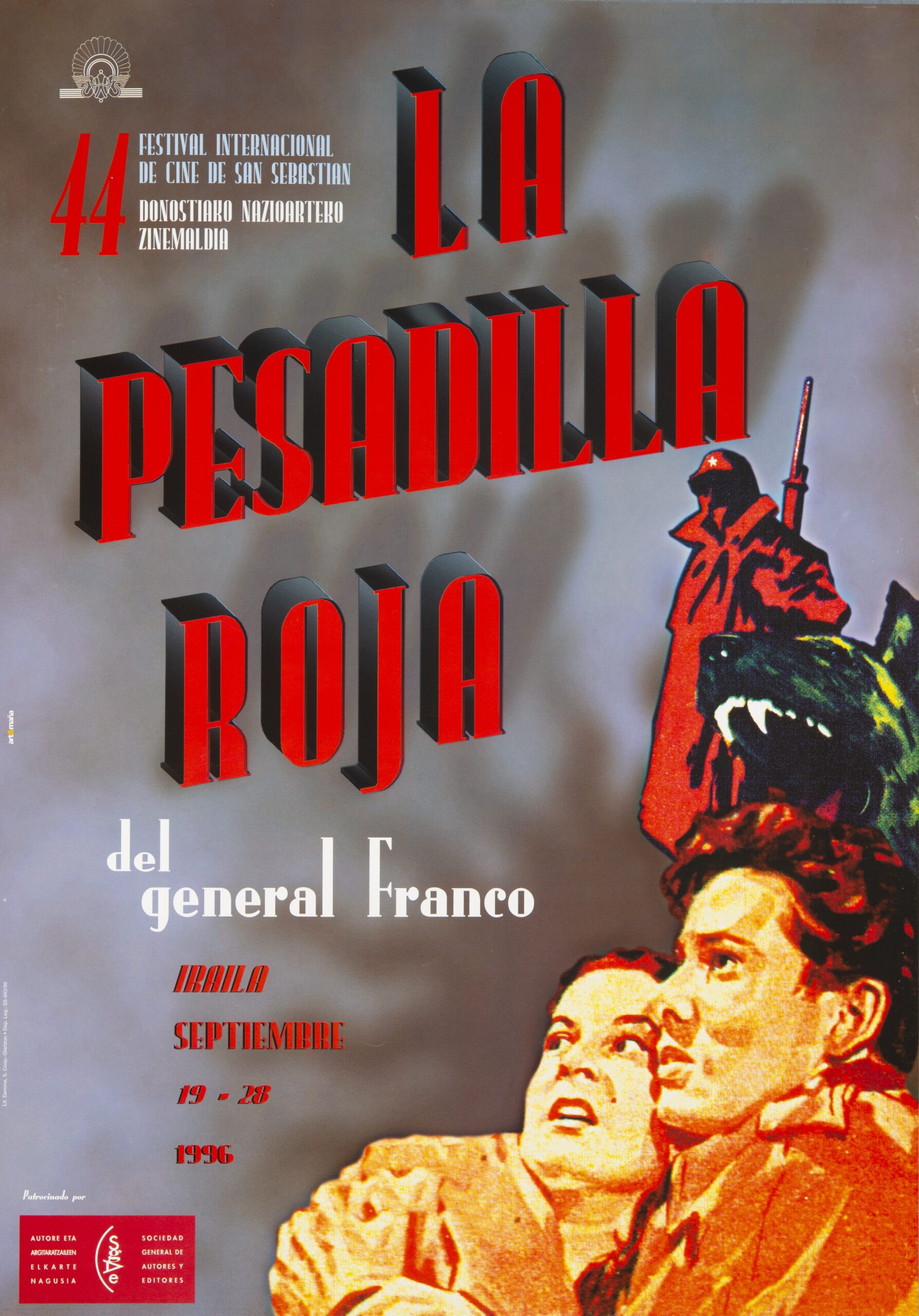
Under the title La pesadilla roja, in 1996 the San Sebastián Festival launched a season with the aim of re-examining anti-Communist discourse in the cinema. The proposal was grouped into two programmes focused on different film-making spheres; two nightmares, painted in the same colour. One, that of senator McCarthy, pondered on films in the United States during the Cold War. While the other, that of General Franco, turned its sights, sixty years after the start of the Civil War, on the part of Spanish film production made during Franco’s dictatorship. “All periods build their ruins and coexist with their own obsolescence” opened the prologue by Manuel Vázquez Montalbán in the book written by the critic Carlos F. Heredero to accompany the programme centred on Spain. With these words, he drew the analytical lines of the proposal: ruins and obsolescence, history and present day.
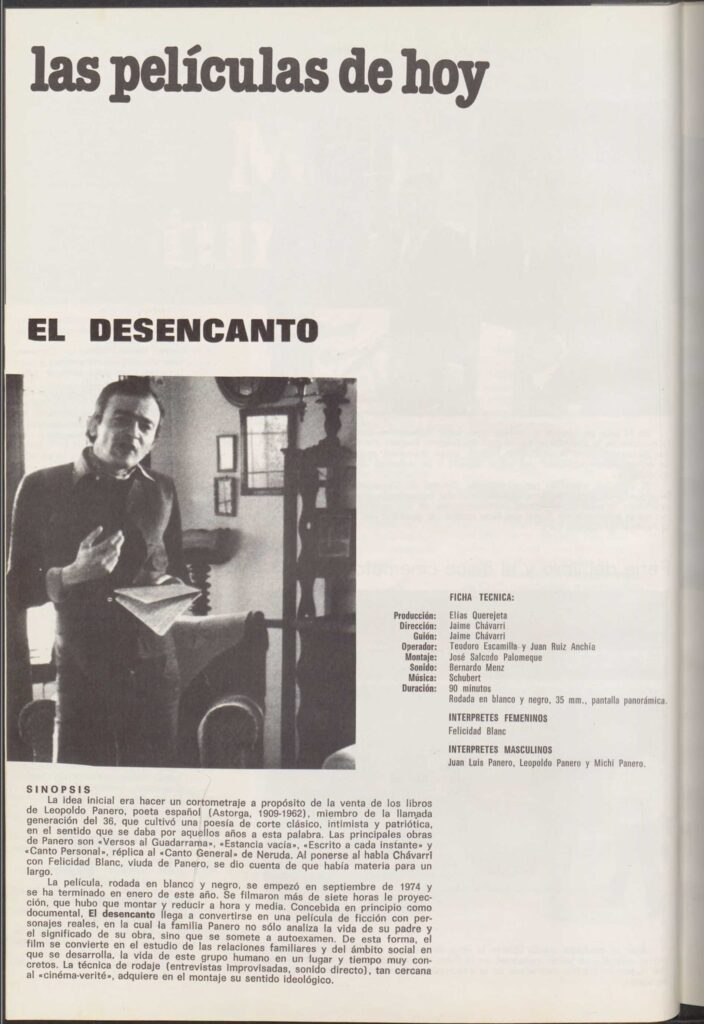
The programme dedicated to anti-Communist cinema produced during the Franco era was made up of ten films. Rafael Gil, who had been, ironically, winner of the first best feature film accolade in the history of the Festival at its 1953 edition, was the director to boast the presence of most films: La señora de Fátima (Our Lady of Fatima, 1951), in which threeshepherd children are surprised by the apparitions of an Our Lady with obvious anti-Communist overtones; Murió hace quince años (He Died Fifteen Years Ago, 1954), a melodrama on the life of a Spanish man educated in the Soviet Union as a child and his return to Spain to fulfil a complex political mission; and El canto del gallo (1955), about the fears of a priest persecuted in a country governed by Communism. Also showing in the season were the films Rojo y negro (1942) and Raza (1941), the only two on the programme to have been made in the 40s. The former, directed by Carlos Arévalo and despite its obvious phalangist manufacture, had been banned by the Franco regime three weeks after its release for taking a somewhat humanised approach towards its republican protagonist, and was discovered and restored by the Filmoteca Española in 1996. The latter, written by General Franco himself and directed by José Luis Sáenz de Heredia, had returned to the period’s model of patriotic national cinema. At a round table on the season, F. Heredero identified in these works two of the regime’s ideological myths: the liberating struggle of the Francoist hordes and that of the rich place threatened by the foreign enemy. The images, governed by the viewpoint of the dictatorship, had been an essential instrument for shaping an own reality.
“Everything built in the Franco years was born as material or spiritual ruin, no matter whether it occurred in the sphere of politics, or of culture because, like in all totalitarian systems, Franquismo endeavoured to operate an ubiquitous strategy of behaviour that supplanted any suggestion of memory and any suggestion of desire” continued Vázquez Montalbán in his prologue. The poster for the season, preserved by Artxiboa, illustrates the idea. “La pesadilla roja” (“The Red Nightmare”) in scarlet letters, centre of the drawing and of the season, stands out from the background due to its angle and shading. Underneath, “Del general Franco” (“of General Franco”) in lower case and in white, expression in Spain of a common ghost for the dictatorial regimes of the 20th century. And relegated to the lower corner of the poster, a couple look to the left with terror in their eyes: out of sight, danger lurks.
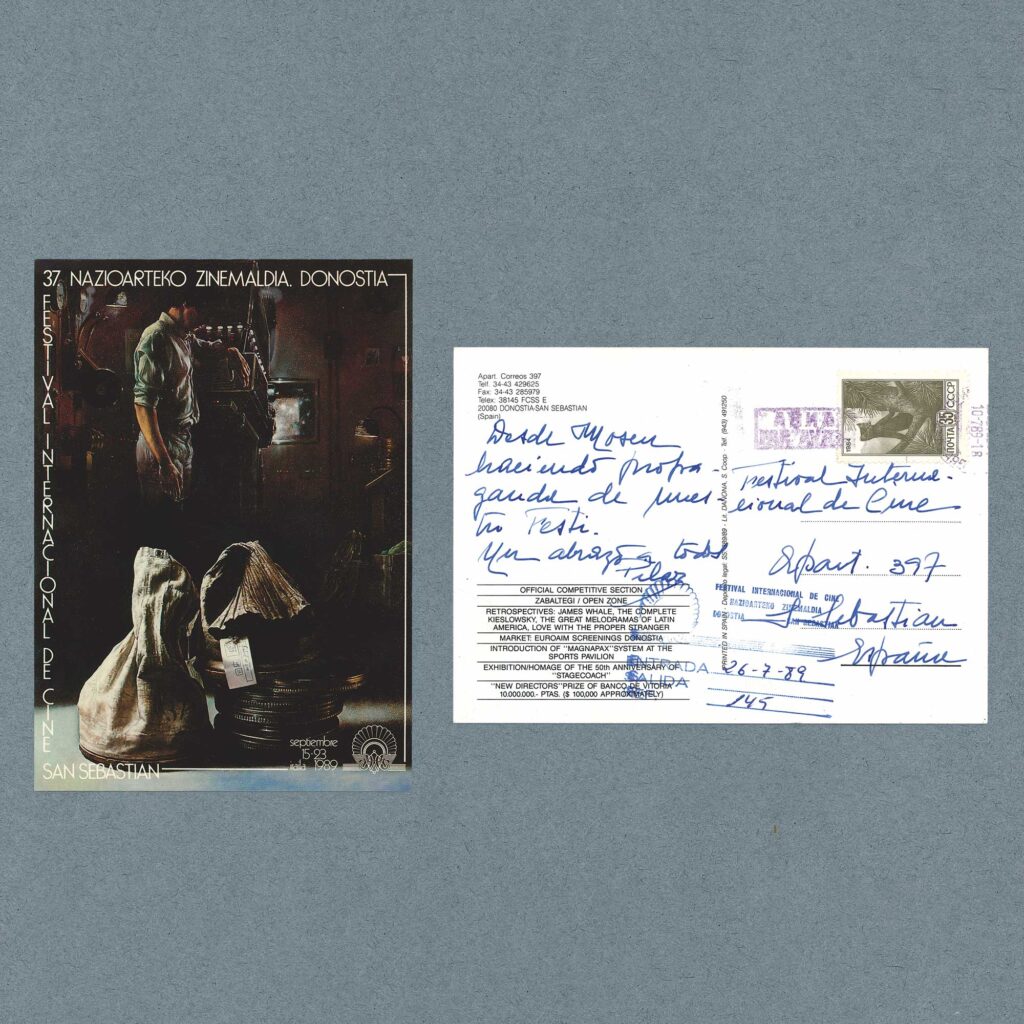
Postcard sent from Moscow by the Festival’s General Secretary, Pilar Olascoaga (1989) San Sebastian Festival Archive. [+]
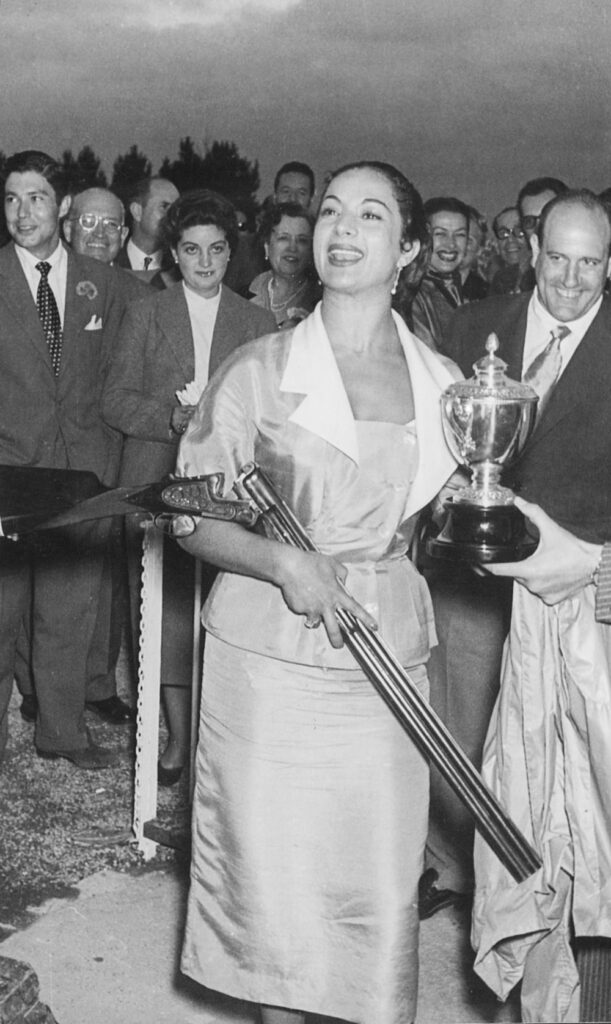
The actress and singer Lola Flores receiving a trophy after attending the pigeon shooting (1954) San Sebastian Festival Archive. [+]
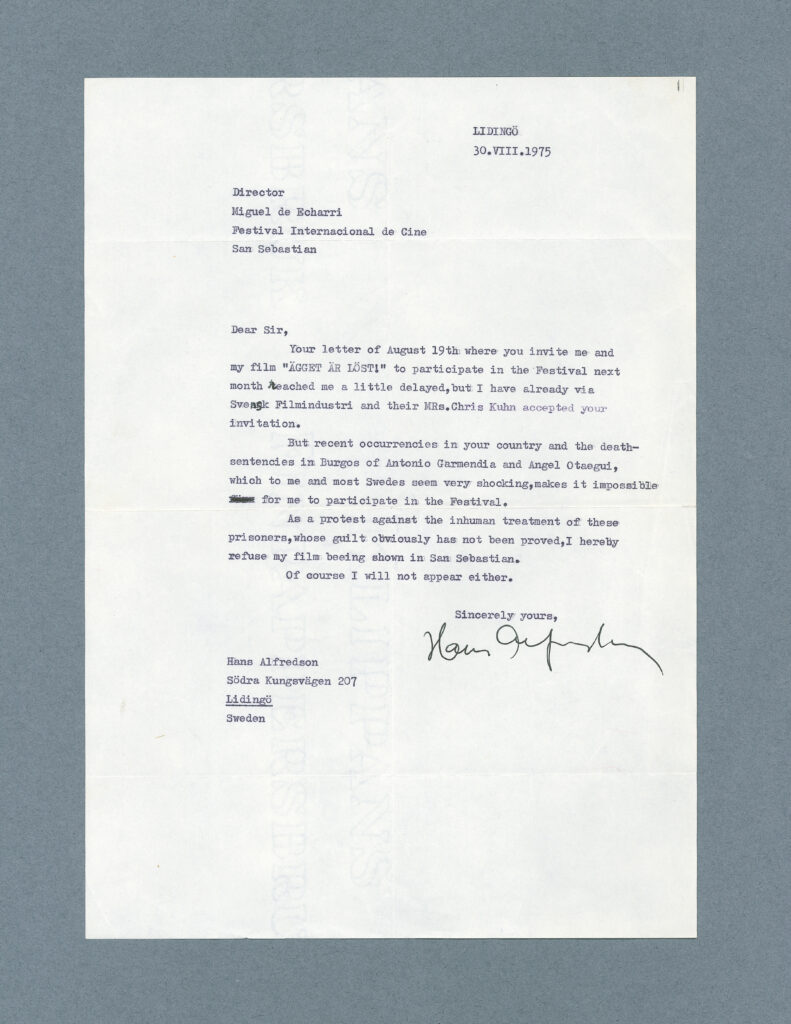
Letter of refusal from director and actor Hans Alfredson to participate in the Festival following the death sentences of Antonio Garmendia and Angel Otaegui (1975) San Sebastian Festival Archive. [+]
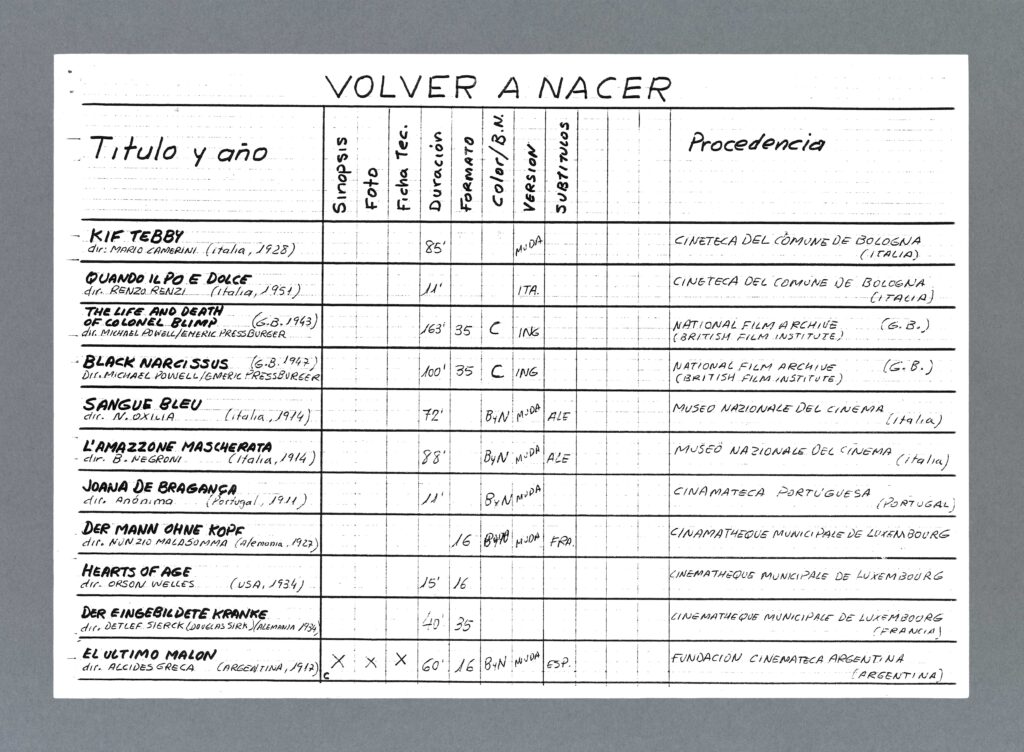
Internal programming document relating to the retrospectives “Volver a nacer” and “Harry d’Abbadie d’Arrast” (1990) San Sebastian Festival Archive. [+]
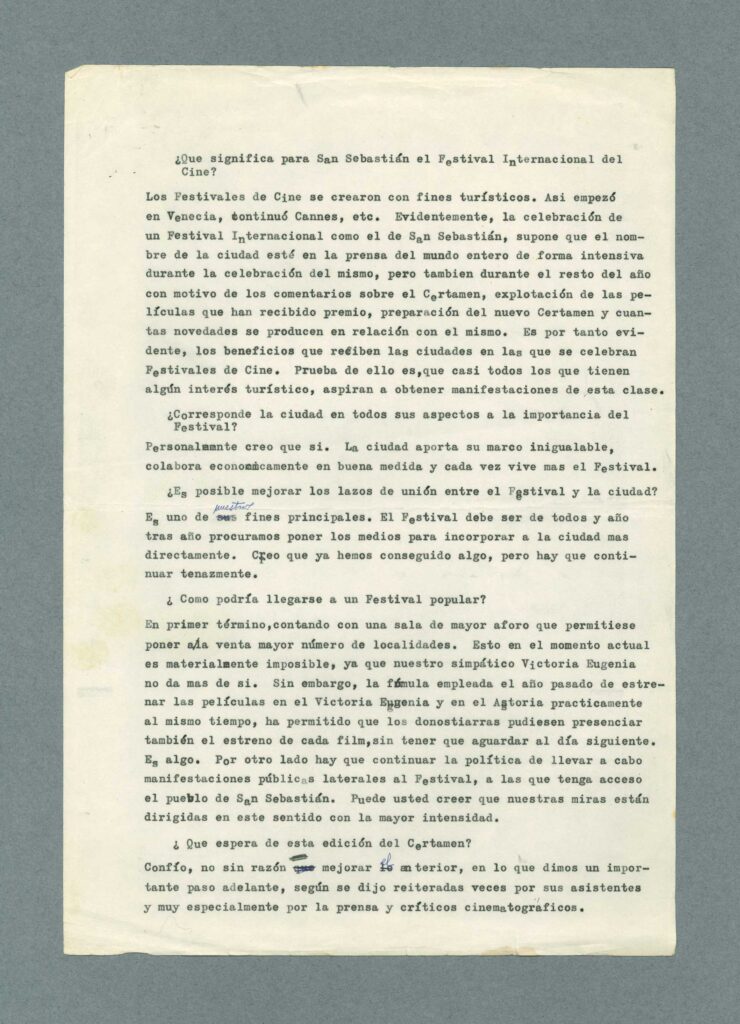
Interview with the competition organisers prior to the 16th edition in 1968 (1968) San Sebastian Festival Archive. [+]
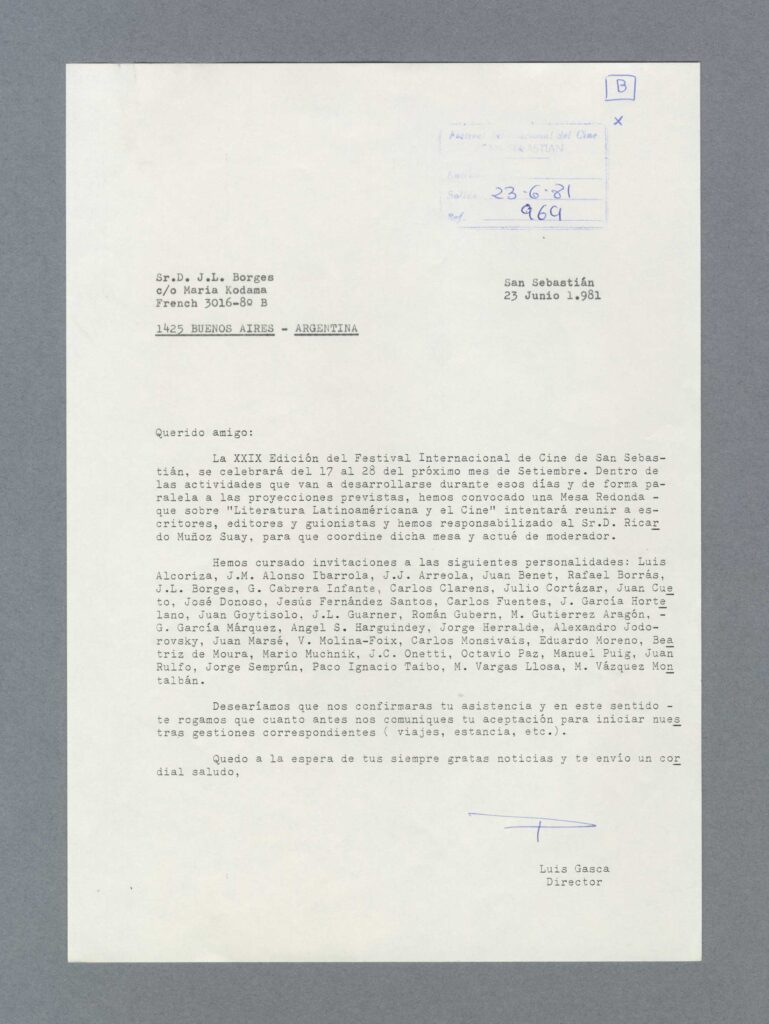
Letter from Luis Gasca to Jorge Luis Borges on the occasion of his participation in the round table discussion ‘Latin American Literature and Cinema’ (1981) San Sebastian Festival Archive. [+]
Actress Gina Lollobrigida presenting the San Sebastian Award for Best Female Performance to the distributor Procinor for “A Woman Under the Influence” (1975) San Sebastian Festival Archive. [+]
The actress Josefa Flores González, better known as Marisol or Pepa Flores, at the Hotel María Cristina (1960) San Sebastian Festival Archive. [+]
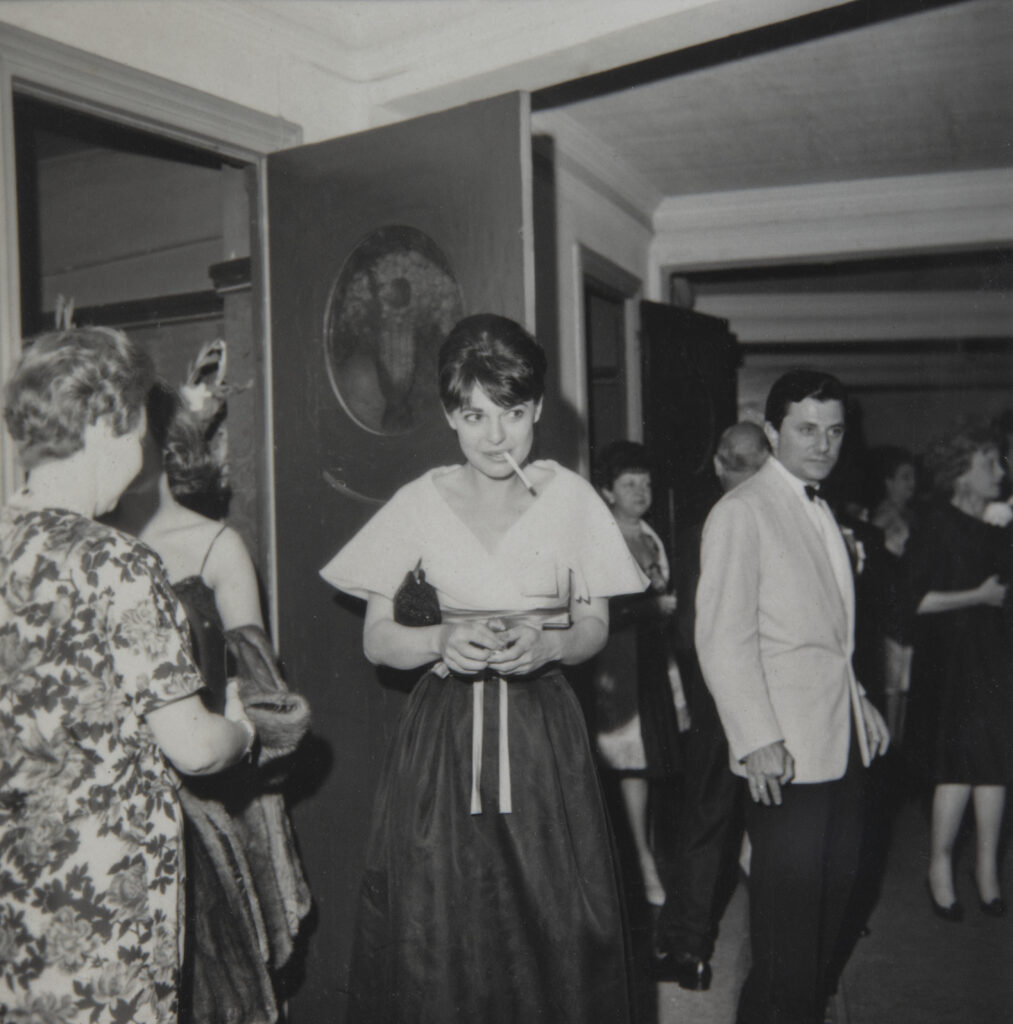
Anne Bancroft at the Victoria Eugenia Theatre’s boxes entrance during the presentation of the film “The Miracle Worker” (Arthur Penn) (1962) San Sebastian Festival Archive. [+]
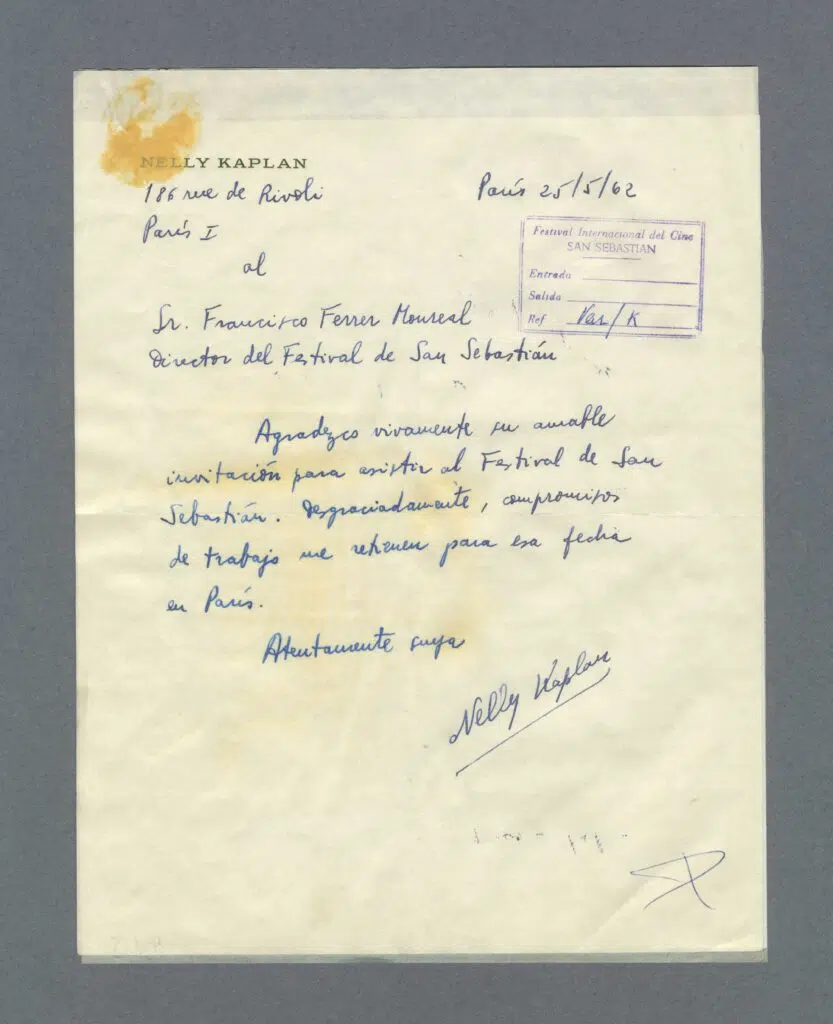
Letter from Nelly Kaplan to Francisco Ferrer on the invitation to the festival (1962) San Sebastian Festival Archive. [+]
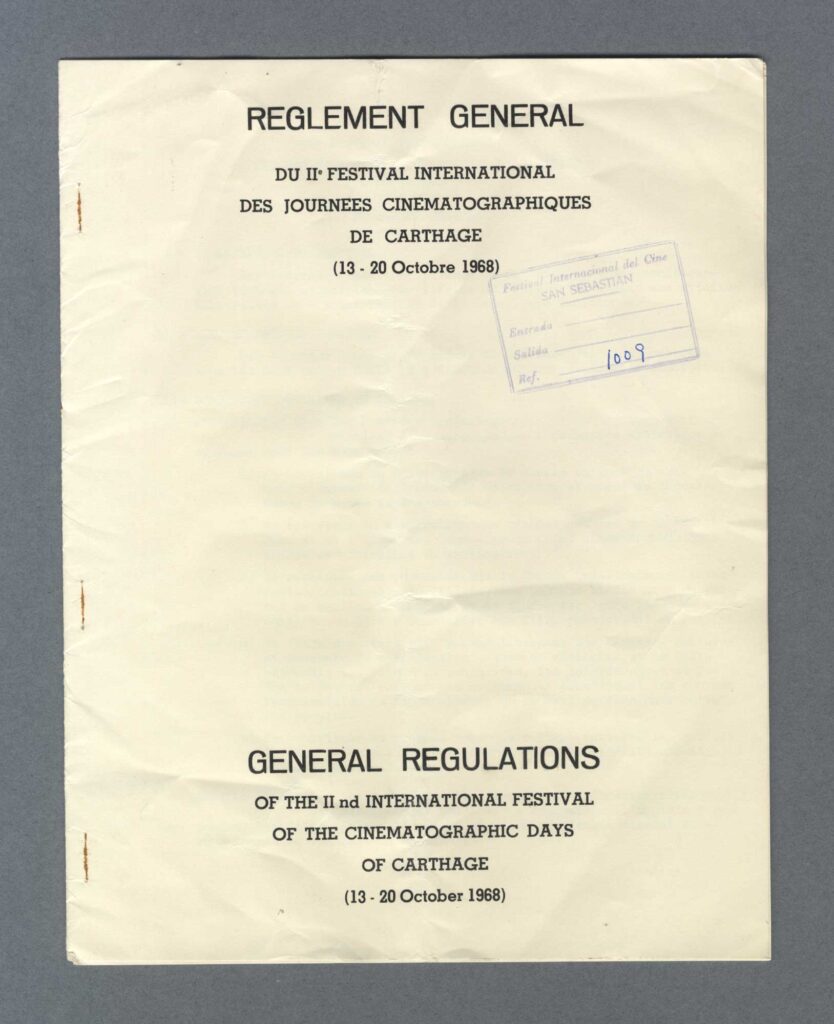
Regulations of the II Cartago International Film Festival (1968) San Sebastian Festival Archive. [+]
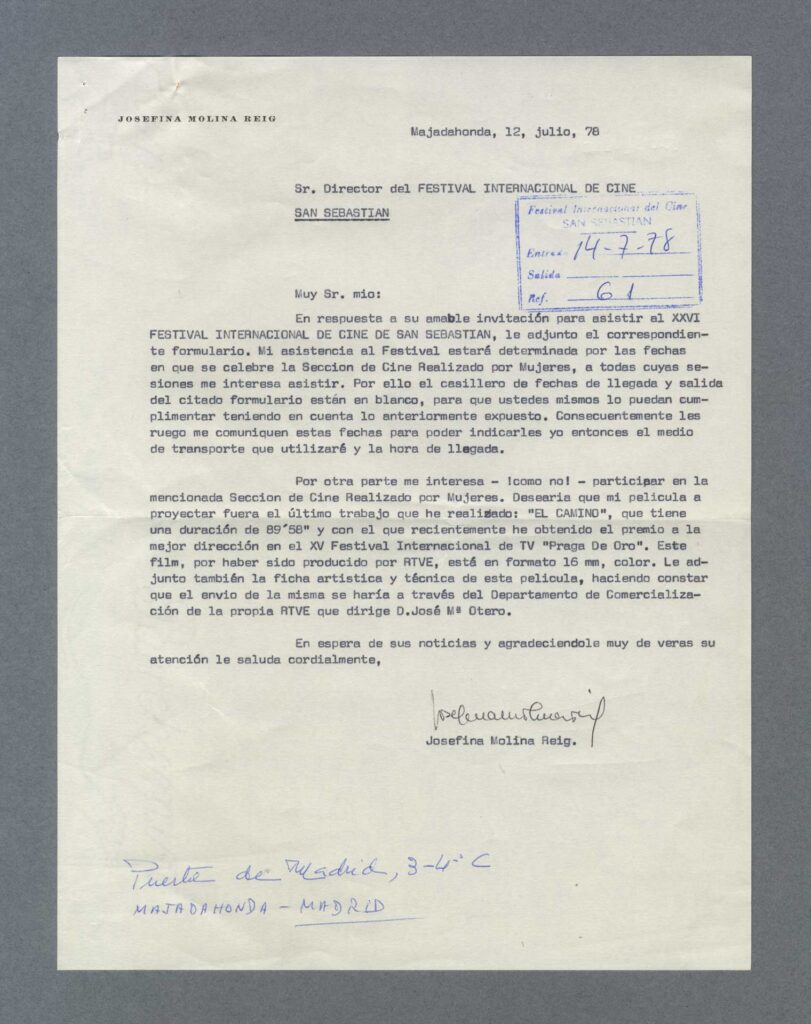
Letter from Josefina Molina to the Festival organisers (1978) San Sebastian Festival Archive [+]
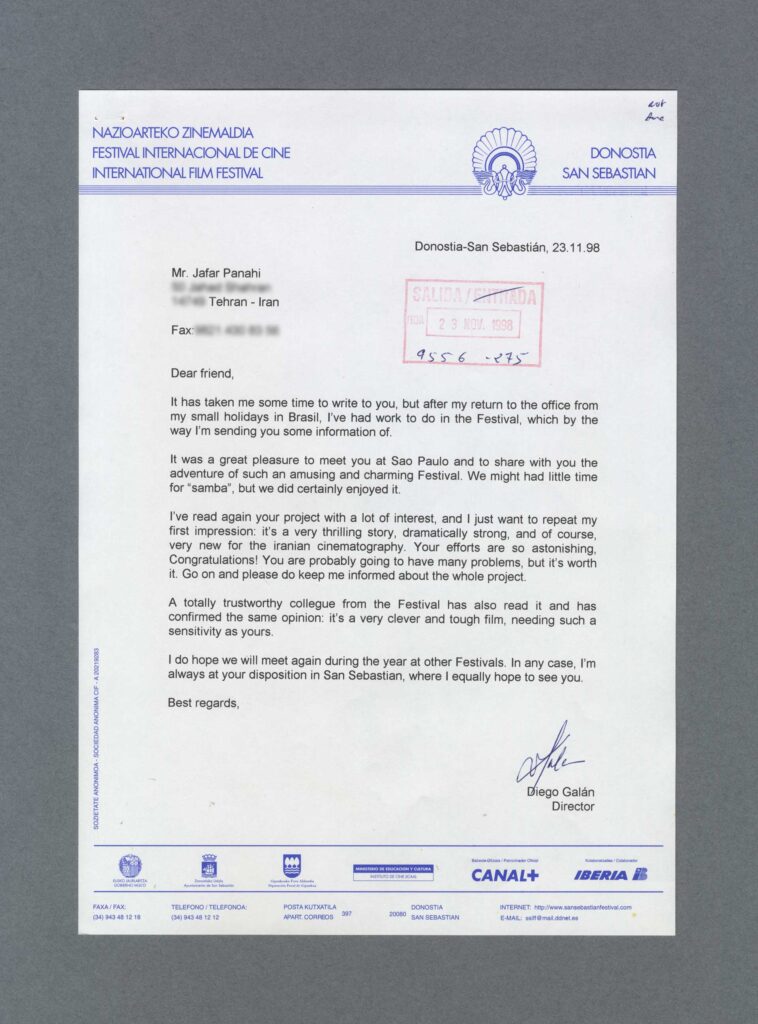
Letter from Diego Galán to film director Jafar Panahi (1998) San Sebastian Festival Archive. [+]